Authentication
Send an API key as a bearer token on every request. The key names the project, its scopes decide which endpoints it may call, and a bad key answers 401.
Every request to the API carries an API key in the Authorization header, as a bearer token. The key proves who is calling, names the project the request acts on, and carries the scopes that decide which endpoints it may call.
curl https://api.useinfrared.com/v1/usage \
  -H "Authorization: Bearer $INFRARED_KEY"
const response = await fetch("https://api.useinfrared.com/v1/usage", {
headers: { Authorization: `Bearer ${process.env.INFRARED_KEY}` },
});
const usage = await response.json();import os
import requests
response = requests.get(
"https://api.useinfrared.com/v1/usage",
headers={"Authorization": f"Bearer {os.environ['INFRARED_KEY']}"},
)
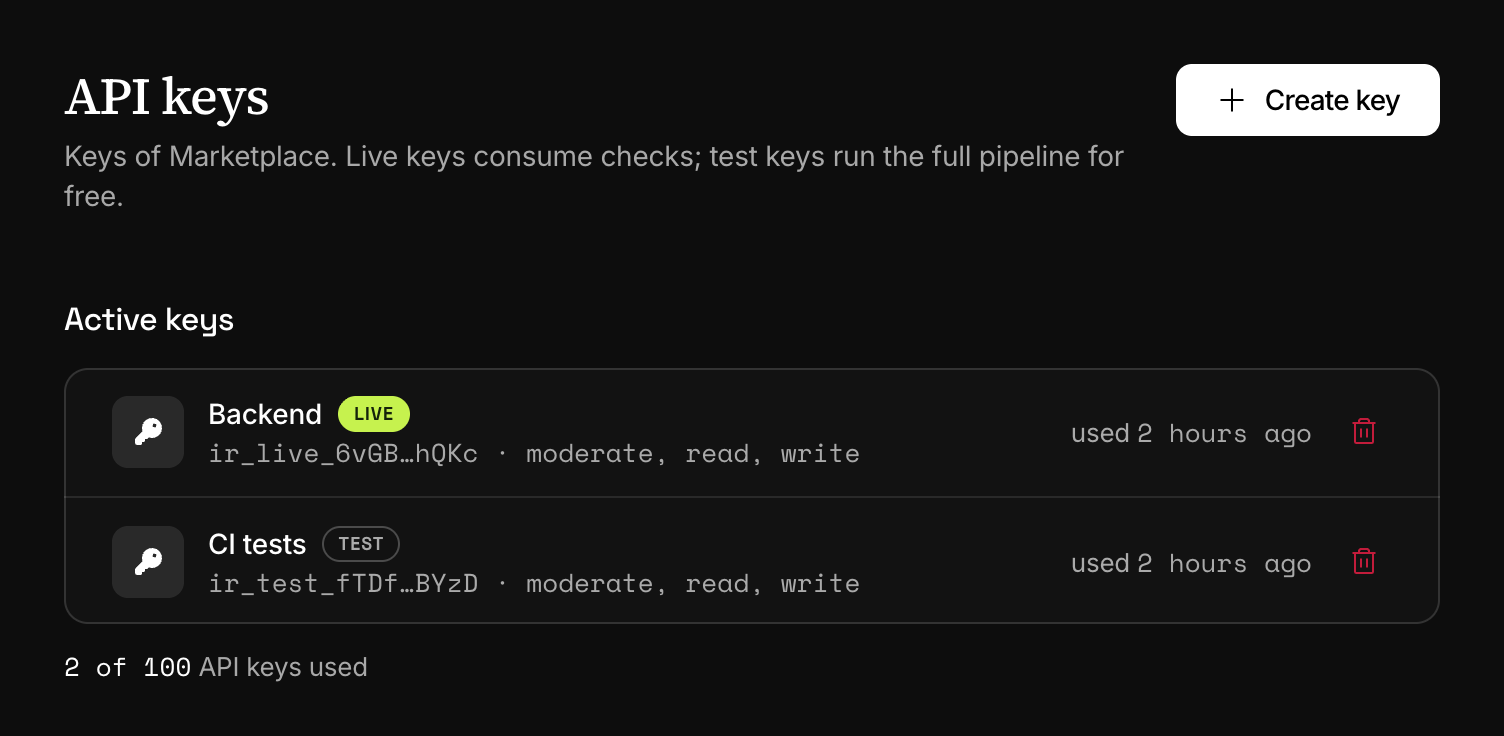
usage = response.json()You create and revoke keys in the dashboard, under Settings, API keys. The API has no endpoint for it, so a key can never make another key. API keys walks through creating one.
The header
Authorization: Bearer ir_live_...- The word is
Bearer, with a capital B, then a space, then the key. A lowercasebearer, another scheme, or a key in the query string counts as no key at all. - A key is
ir_live_orir_test_followed by 32 letters and digits, 40 characters in all. - Infrared stores a hash of the key, never the key. It is shown once, when you create it.
What a key can reach
A key belongs to one project. Lists, lookups and writes are all scoped to it, and no path carries a project id. A resource of another project answers 404, as if it did not exist.
A test key authenticates the same way and reaches the same project. Only the creation of a moderation treats it differently: no checks are used, usage is counted apart and author history is left alone. Every other call made with a test key changes real data.
Scopes
A key has one or more of three scopes. Each endpoint asks for exactly one, and scopes do not include one another.
| Scope | Endpoints |
|---|---|
moderate | POST /v1/moderations, POST /v1/moderations/batch, POST /v1/moderations/{id}/remoderate and POST /v1/templates/{slug}/test. |
read | Every GET: moderations, templates, policies, guidelines, wordlists and their terms, authors, the queue, actions, webhook endpoints with their events and deliveries, and usage. |
write | Authors: create or update, block, suspend, enable. Queue: resolve, reopen. Actions: execute. Guidelines, wordlists and their terms: create, update, delete. Webhooks: create, update and delete an endpoint, rotate its secret, replay a delivery. |
Two consequences to plan for:
- Polling needs
read. A key withmoderatealone can start a queued moderation and cannot fetch its result withGET /v1/moderations/{id}. - Scopes are fixed. A key's scopes cannot be changed after it is created. Create a new key and revoke the old one.
When a key is refused
{
  "error": {
    "code": "missing_api_key",
    "message": "Missing or invalid Authorization header",
    "details": [],
    "request_id": "req_63717b6414df41308492b50dba455cc4"
  }
}| Status | Code | When |
|---|---|---|
| 401 | missing_api_key | There is no Authorization header, or it does not start with Bearer. |
| 401 | invalid_api_key | The key is malformed, unknown, revoked or expired. The answer is the same for all four. |
| 403 | insufficient_scope | The key lacks the scope the endpoint asks for. The message names it: This API key does not have the write scope. |
A revoked key stops working at once, and an expired one at its expiry time. Neither comes back: create a new key.
A request refused with 401 does not count against the rate limit. One refused with 403 does.
Next
- API keysA key signs every request and decides which project it lands in. Create one for each place that calls Infrared, with only the scopes it needs.
- Test modeA test key runs the whole pipeline and uses no checks. It is not a sandbox: its moderations still reach the review queue and your webhooks.
- ErrorsEvery error has one JSON shape. Branch on its code, show its details and quote its request id. The table lists each code the API returns and when.
- Rate limitsEach API key may send a set number of requests a minute, by plan. Every response says where the key stands, and a 429 says how long to wait.
Something missing or unclear on this page? Write to support@useinfrared.com.